
The short answer
- There is no best optional in this data. Subjects with the highest medians were not the ones with the best ranks.
- PSIR, Sociology and Anthropology are the most common among toppers in our records, with 37, 36 and 28 records. Popularity brings more coaching, more notes and more peers, which helps some people.
- Mathematics has the highest median among subjects with 15 or more records, but only 17 records, so treat it carefully.
- Law and Hindi Literature have the lowest medians among subjects with ten or more records, yet both still produced toppers.
- Choose based on your background, your interest and how much material and guidance you can access, not on a one-point difference in median marks.
 Gilu saysTip: a 10-mark gap in a median is smaller than the gap between the same candidate's first and second attempt. Do not choose on it.
What marks toppers scored by optional
Marks are the sum of Optional Paper I and Paper II, out of 500, for toppers in 2022 to 2025. We only show subjects with at least ten usable records.
| Optional | Records | Median | Middle half (25th to 75th) | Highest | Toppers in top 100 |
|---|---|---|---|---|---|
| Mathematics | 17 | 289 | 274 to 310 | 312 | 7 |
| Anthropology | 28 | 281.5 | 271 to 293 | 326 | 7 |
| Geography | 22 | 279 | 273 to 283 | 298 | 4 |
| Sociology | 36 | 278.5 | 262 to 288 | 315 | 15 |
| Economics | 10 | 278 | 262 to 295 | 299 | 3 |
| PSIR | 37 | 267 | 258 to 282 | 304 | 7 |
| Law | 14 | 259.5 | 253 to 274 | 288 | 5 |
| Hindi Literature | 10 | 258.5 | 252 to 266 | 282 | 1 |
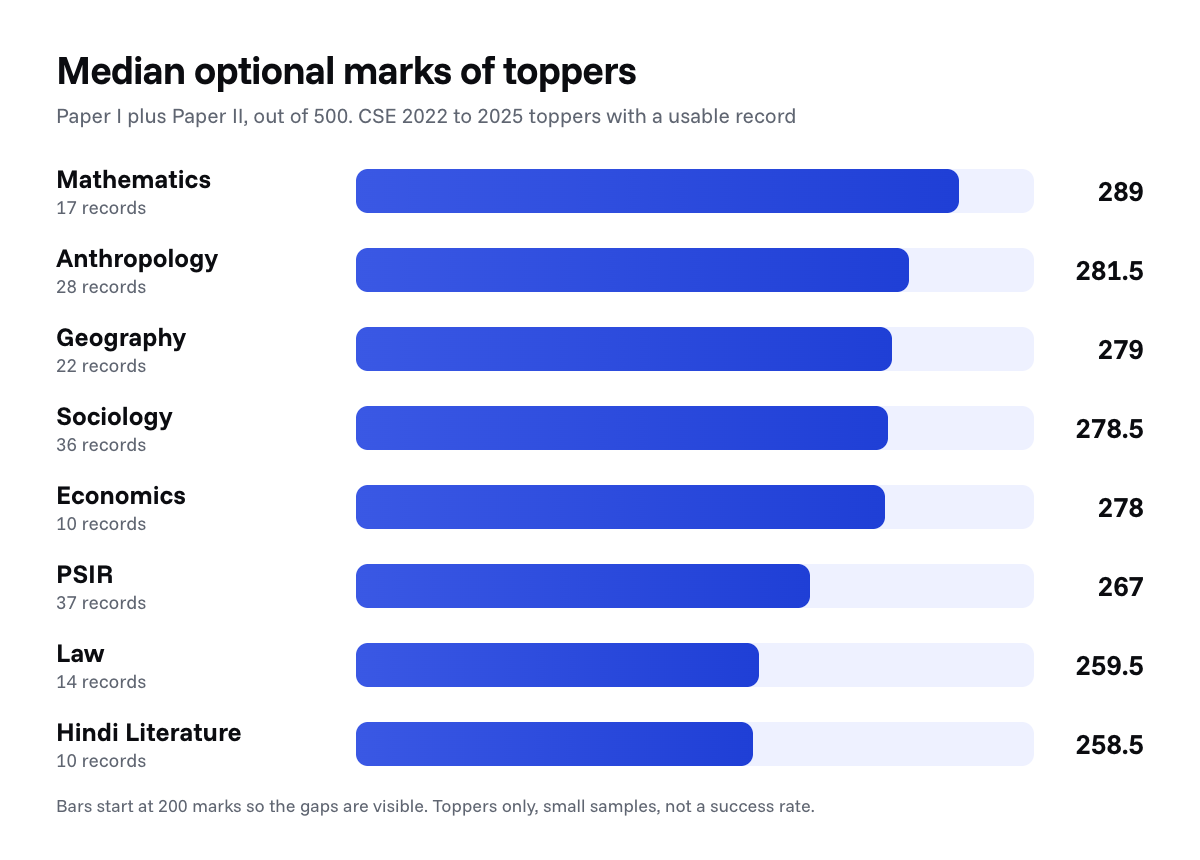
How we got these numbers. Of 379 toppers in our database for 2022 to 2025, 239 had a recognisable optional subject and plausible marks in both optional papers (between 40 and 250 each). The other 140 records were excluded for missing or inconsistent marks. We merged spelling variants of the same subject, for example "Political Science & International Relations" with PSIR.
Choosing is the easy part. Writing answers that score in your optional is the work.
63 handwritten Mains copies from 27 toppers, with marks. 7-day refund.
What the table does and does not show
A higher median is not a better rank. Mathematics has the highest median at 289, and its toppers in our records have a median rank of 120. PSIR has a median of 267 and a median rank of 210. Sociology has a median of 278.5 and a median rank of 194, with 15 of its 36 records in the top 100. Different subjects are marked differently, and the final rank also depends on GS, essay and interview.
Small samples wobble. Mathematics has 17 records, Economics has 10 and Hindi Literature has 10. One strong or weak year can move a median by several marks. We hid subjects with fewer than ten records for this reason.
Survivorship bias. These are people who ranked well. If a subject has a harder paper and many candidates fail with it, you do not see them here. Likewise, a popular subject may show up often simply because more people choose it.
Marks are not the whole story. Scoring depends on your answer writing and on the evaluator, and the same candidate can score differently in different attempts. Our optional marks analysis looks at total Mains marks and GS correlation for an earlier set of rank holders, and our guide on how to write Mains answers covers the skill that decides your optional score.
A simple way to decide
Use these in order. Stop when one gives a clear answer.
- Your graduation subject, if you liked it. Years of background help, but only if you want to keep studying it. A degree you disliked is not an advantage.
- Overlap with GS. Subjects such as Geography, PSIR, History and Sociology share ground with GS papers. That saves time, but the optional paper still needs separate depth.
- Syllabus size and your time. Look at the syllabus and last five years of papers. Can you finish it twice before Mains? If not, choose a smaller syllabus.
- Access to guidance. Notes, a mentor or test series for the subject. Popular subjects have more, and rarer ones may require more self-reliance.
- Your interest. You will read this subject for a year. Boredom costs more marks than a slightly lower median.
 Gilu saysTip: read two years of question papers in the subject before you commit. If you can imagine answering them, that is a good sign.
Choosing is the easy part. Writing answers that score in your optional is the work.
63 handwritten Mains copies from 27 toppers, with marks. 7-day refund.
Five mistakes people make
- Choosing on last year's topper. One year's topper tells you about one person's preparation, not about the subject.
- Choosing a subject for "scoring". Our data shows medians sit within about 30 marks of each other for the larger subjects. Preparation quality outweighs that gap.
- Switching late. Changing optional close to Mains throws away months of effort.
- Ignoring the paper pattern. Some optionals reward structured theory, others diagrams, data or numerical working. Match it to how you answer best.
- Skipping answer writing in the optional. The optional is 500 marks, and half the work is practice. Review your answers against real copies.
If you want to see how toppers wrote their answers in their optional and GS papers, the Answer Copies Compilation has 63 real Mains copies from 27 toppers, and the Mains 2027 Pack brings topper notes together.
What we do not know
We do not have success rates by optional, meaning the share of all candidates who clear Mains with each subject. We also do not have marks for candidates outside our topper records. Without those, any claim that one optional is "easier" or "safer" is a guess, including ours.
We will update this page when we extend the data. If you spot an error in a subject's records, write to us and we will check it against the UPSC documents.
Frequently Asked Questions
Which optional subject is best for UPSC?
There is no best optional in the data we have. Median optional marks of toppers range from about 259 to 289 out of 500 across the larger subjects, and the highest median did not match the best ranks. Choose on your background, interest, syllabus size and access to guidance.
Which optional subject scores highest?
Among subjects with at least ten records, Mathematics has the highest median (289 out of 500, 17 records), then Anthropology (281.5, 28 records). Samples are small and limited to toppers, so a few marks of difference means little.
Is a popular optional like PSIR or Sociology safer?
Popularity means more guidance and test series, which helps many people. In our records PSIR (37), Sociology (36) and Anthropology (28) are the most common among toppers, but we have no success-rate data to say they are safer.
Should I choose my graduation subject as optional?
If you liked it, yes, because the background saves time. If you did not enjoy it, a degree alone is not a good reason.
How many marks does the optional carry?
The optional has two papers of 250 marks each, 500 in total, out of 1,750 in Mains.
Does the optional decide the final rank?
It is 500 of 1,750 Mains marks, so it matters, but GS, Essay and the 275-mark interview also count. Marks in the optional vary by evaluator and by your answer writing.
Data and method
Free UPSC Study Material
2,700+ resources — test series, notes, books, magazines. Download free from top coaching institutes.
Prepare your optional and GS with topper material
The Mains 2027 Pack. Instant email delivery, 7-day refund.
See the Mains 2027 Pack